Insight · Published September 2026
By Marin Tintchev, Founder, GeoSynapse & China GEO EU
Cross-Ecosystem, Not Cross-Border: Why China and Europe Aren't Symmetrical AI Environments
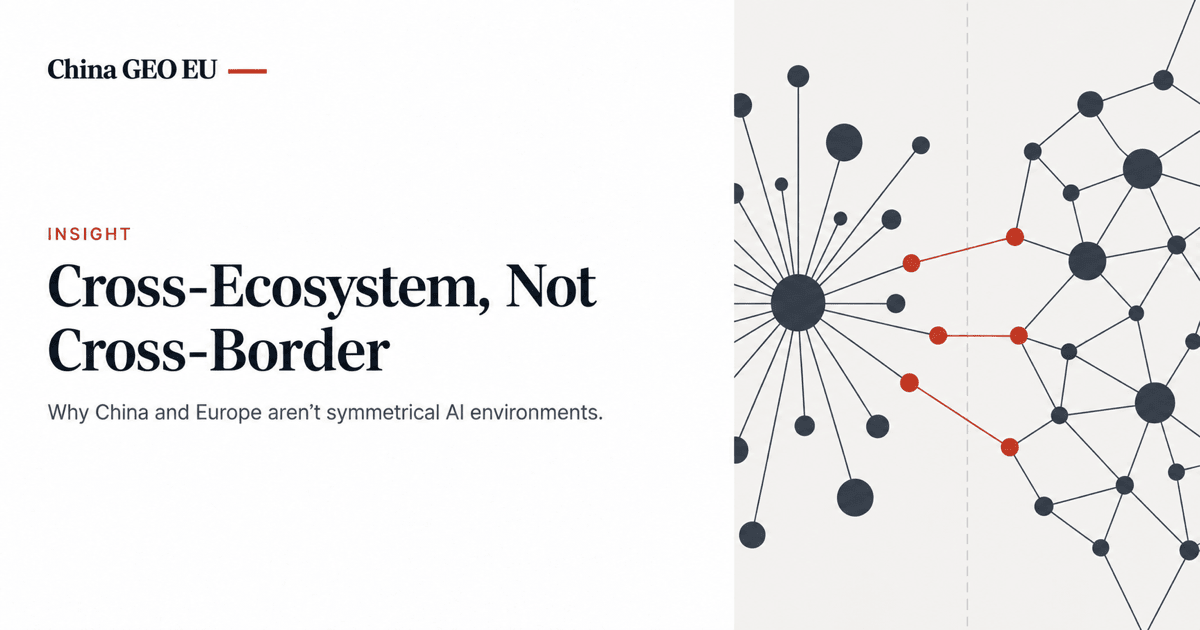
"Cross-border" is a geographic and regulatory frame. It understates what's actually different about entering the Chinese AI-mediated information environment from a European one.
Why isn't entering the Chinese AI-discovery environment the same as entering any other new market?
Most market-entry language treats China and Europe as two markets separated by geography, language and regulation — a "cross-border" problem, solved by localization and compliance. That framing isn't wrong, exactly. It's incomplete for what we actually work on, which is how a company is represented inside AI-mediated discovery — a problem that is technological and informational before it is geographic.
FACT
Do China's AI platforms operate under a formal registration regime?
Yes. Since August 2023, public-facing generative AI services in China have been required to file with, and be approved by, the Cyberspace Administration of China (CAC) before public release. As of the most recent official count we found, 346 generative AI services had been registered under this regime[1], with further filing batches processed through 2025[2]. This is an ongoing, institutionalized approval process — not a one-time rule.
FACT
Is usage concentrated among a small number of major Chinese AI platforms?
Yes. Independent market-data reporting shows Chinese consumer AI usage concentrated among a handful of major domestic platforms — led by ByteDance's Doubao and DeepSeek, with Tencent, Ant Group and Alibaba also among the top five by weekly active users[3]. That is a real, sourced concentration pattern, not an assumption.
INTERPRETATION
What do we conclude from this — and what don't we claim?
We haven't found a primary source stating this comparison directly — it's our own interpretation, built on the two facts above plus the observable fragmentation of the Western AI landscape across many independent providers (OpenAI, Google, Anthropic, Meta, Mistral, xAI, Perplexity and others).
What we think this means practically: a company preparing for AI-mediated visibility in China is not just translating content into Chinese and adjusting for local competitors. It is entering a discovery environment with a different platform structure, different regulatory gatekeeping, and different default retrieval behavior than the fragmented Western environment most European companies already navigate. That is the actual problem — not the border.
Why does this distinction matter for how we work?
It's why our Methodology treats the Chinese and Western platform sets as requiring separate testing logic rather than one script translated twice, and why our approach to execution in China exists specifically for the Chinese-platform layer, rather than trying to run one undifferentiated process across both environments.
References
- "346 generative AI services registered with China's cyber authority," State Council Information Office / CGTN, english.scio.gov.cn (9 April 2025).
- Digital Policy Alert, CAC generative-AI filing tracker, digitalpolicyalert.org (ongoing 2025 filing batches).
- "ByteDance, other major Chinese tech firms dominate local consumer AI market," South China Morning Post, citing QuestMobile data, scmp.com (24 December 2025).
Frequently asked questions
Does a company already visible to ChatGPT or Google automatically have visibility in China?
No. Visibility on Western AI systems and Google doesn't transfer to Chinese platforms — the two ecosystems draw on almost entirely separate source material, a distinction covered in more detail in "The Chinese AI Visibility Gap."
Is "cross-ecosystem" a problem unique to China?
The same logic applies wherever an AI platform landscape is structurally different from the one a company already operates in — China is the sharpest current example because of how concentrated and separately-regulated its platform set is, not because the underlying problem is exclusive to it.
Does entering the Chinese AI-discovery environment require a separate legal entity or local partner?
That's a business/operational question outside the scope of this piece — this article addresses AI-platform visibility specifically, not corporate structuring or market-entry logistics.
About the author
Marin Tintchev is the founder of GeoSynapse and China GEO EU. He has 30+ years in ICT and international business across China and Europe, was educated at Tsinghua University, and is fluent in Mandarin.